The Blog

The Shelf-Life of Hobbies: Love ’em or Leave ’em

craft-office_optHobby\noun: a pursuit outside one’s regular occupation engaged in especially for relaxation.

By definition, a hobby is an activity we choose to engage in because it relaxes us.  It brings us immeasurable pleasure. Some hobbies live on forever because they are active and well-preserved.  For the most part,  I’ve seen them come and ‘go,’ in theory, but they rarely seem to actually exit the home.  They often remain in the home on a dusty shelf somewhere in the attic or buried in a box in the basement and/or garage.

During the organizing sessions with my clients, I often discover neglected hobbies.  Here’s how the conversation usually goes during the organizing process;

Organizer (me):  I notice you have an abundant yarn inventory, knitting needles, instruction manuals, etc.  Are you an avid knitter?

Client:  Well, I use to knit all the time many years ago, but I don’t anymore.  I rarely find the time and my interest has waned.

This is a tough one.  As life changes, our interests and passions change too. The longevity of our hobbies may be questionable.  ‘Letting go’ of a hobby once loved can be emotionally difficult. It’s bidding farewell to a piece of your past. Perhaps establishing some criteria would be helpful in the decision-making process.

If you have abandoned your old hobbies and they are strewn all over your house or living on dusty shelves, ask yourself;

  • How important is it in your life today?
  • When was the last time you paid it any attention?
  • Do you still love it and intend to return to it?
  • Does it have any monetary value?
  • What personal value does it serve you to hold onto it?


Clearly, if your hobby and its components are dated, in disrepair, or unusable, consider letting them go.  If they are no longer relevant in your life but can benefit someone else’s, think about donating it to those who will enjoy it. No need to clutter the home at all, albeit with a neglected hobby.

But if you have a hobby that still brings you continuous pleasure, whether it be crafts, painting, pottery, carpentry, books, coins, etc. designate a beautiful space for them. It is far more enticing to play and enjoy when you’ve created a proper home and can organize all the accompaniments.

Honor and respect your hobbies with “pride of place. ” If your hobby or hobbies are active, housing the hobby is an essential piece of its preservation.  These are some of the key elements to consider;

Storage is paramount.  It doesn’t have to be fancy or super high-tech, but a simple system will keep the hobby accessible, organized, and live in an exclusive place.  Things can be easily be retrieved and returned back to their proper home.  It’s important not to impede on other family common spaces.

I love clear organizing cubes for storing tiny crafts (buttons or beads)  http://ow.ly/w5OOl or for small hardware (nails, screws, hooks) http://ow.ly/w5P0d.  You can corral them all in one place and ‘see’ them.

Space matters.  Anticipate how your hobby may grow.  Too often, the original space is outgrown in a short period of time because it wasn’t designed for growth and change.

Lighting is also an integral component of happy hobby space. Poorly lit spaces emits negative energy, does not foster a high functioning environment, and can cause chronic eye strain.  It’s likely to discourage you from delving into the hobby and enjoying its space. If you are fortunate enough to be near natural lighting or directly adjacent to a window, that’s an ideal setting.  If not, there are multiple halogen lamps and specialty lighting available that provide superior indoor lighting.

Ergonomics of the hobby space is crucial. The hobby table should accompany all that you require in order efficiently work on the project.  Consider purchasing this flexible hobby table that can adjusts to your preferred height. Optimize vertical space with ample shelving to give you additional storage and easy accessibility.  Ditto to the chair, especially if you plan on sitting in it for countless hours.  It may or may not be critical for it to be on wheels, but it is important for it to be comfy. 🙂

So make your hobby or your kid’s hobby succeed and design with optimal functionality in mind.  Children’s Legos and jigsaw puzzles need happy homes too.  Think about it. Have you really invited your hobby into your home?

Don’t leave them out in the cold garage or dark corners of the basement.  Unattended hobbies generally find their way there. Invite them back in or send them on their merry way.  Love them or let them go.

Read this post on single page to comment →

Lark or Owl? How your Habitude Affects Your Productivity

owl jpgWe all have such different predispositions, don’t we? Some of us rise early as the lark, or stay up into the wee hours of the night just like the owl. If we pay attention to these proclivities, perhaps we can use our time more optimally.

Are you an early bird or a night owl?

To know me well, is to know that I am definitely not an early bird. Truthfully, I’m not my ‘natural’ best self early in the morning.  I know this.  It takes my brain a little while to get into a groove and catch up with my body. So in the event when I do need to rise early, I must give myself extra time to adjust and wake up my body and sync it to my brain. I always marvel at those people who start their day really early and have already been to the gym and back, ran some errands, showered, and completed several tasks, way before I’ve even opened my eyes!

I suspect that those early risers are also ‘early to bed’ people too.  Knowing how much sleep you require is important, but actually getting it, is even more essential. We try to calibrate our sleep patterns in accordance with our body rhythm.

There is probably a valid reason as to why I’m not such a an early riser.  I’m really more of a ‘late night’ person, always have been. Although I don’t always get it, I require a minimum of 8 hours sleep every night.  For me, after a busy day, I need several hours in the evening to unwind. After dinner spills into a myriad of to do’s, to calls, and ultimately leads me upstairs to relax and watch some entertaining (sometimes mindless) late night TV.

For most, this is the moment to drift off into a delicious deep slumber. Well that’s not exactly how it works for me, lol.  Firstly, I need quiet to sleep. I cannot fall asleep with ambient voices emanating from the TV, so after my husband finally falls asleep and I’ve had my fill of late night talk shows, it’s light’s out for me.

The interesting phenomenon about my body rhythm is that although I’m asleep, I’m often woken up by my brain in the middle of the night. Thoughts invade, ideas percolate and poke at me. Truly, I am a ‘natural’ night owl, but I’ve learned how to manage this. I always leave a pad and pen by bedside to ‘catch’ my thoughts because I’m afraid I will forget them in the morning. Sometimes I wake up multiple times to remind myself to add to my to do’s for the following day.

When it’s still and quiet, my brain does not shut down.  Actually, the silence activates and provides clear space for me to think.  I must confess, it’s not like I choose to stay up all night, it’s more like an unconscious tug that urges me to empty my brain so I can have a more restful night’s sleep.

I’ve learned to stop fighting the nudge,  and turn on the lamp for a quick jot of genius.  In fact, most of my blogs are crafted from these late night epiphanies.  I jot down key words and phrases, sometimes even full sentences! When I wake up the following morning, I’m frequently shocked that I wrote such legible and focused content in the wee hours of the night. It sometimes feels like I’m ‘working’ in my sleep!

But clearly, every day is not perfect and I cannot manage my required hours of sleep all the time. Without a doubt, after a great night’s sleep, my days are physically active and very productive.  I am operating on full throttle with my best self.  On those other days when I might be more sleep deprived, it’s not so pretty, lol.  My productivity suffers and so does my sleep cycle. I must adjust to catch up.

The key is to know thyself.  Are you aware of when you are your best self? If you are indeed an early bird, are you taking advantage of the gifted hours? Do you use late nights to get more things accomplished?

We all structure our day and use time differently because we all have unique lifestyle and habits. When are you most productive? Lark or owl?

Read this post on single page to comment →

Are You Drowning in Paper?

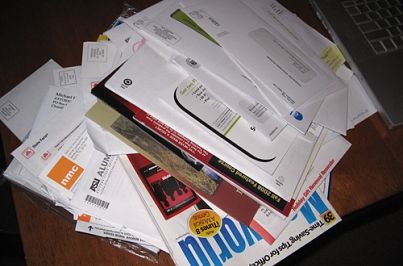
paper mailIt is a fact that the number one violator of clutter, is paper. It is coming into our homes at a faster rate than we can sort it! The good news is that we have options now 🙂


We can choose to go paperless with our finances, bank statements, and bill-paying. We can opt out of the magazines that we know we are never going to read, catalogs and product solicitations, etc.   Visit www.catalogchoice.org and www.optoutprescreen.com.  Simply remove your name from pre-approved credit card lists and type in unsubscribe in the search bar.

But then there’s the other kind of clutter; the virtual culprits. By far, the best and newest e-mail manager is unroll.me.  Bye bye and so long to the countless unwanted e-mail subscriptions we receive that mercilessly clutter our inboxes daily. With this program, you can toss the junk mail with just one click. Once you unsubscribe, you can create your own “rollup” or digest of preferred and favorites, and schedule them to arrive any day you choose, all in one email.  How great is that?

As for the other incoming mail, try to create a nice consistent landing-place, so that the papers requiring your attention will be easily found. Having a mail sorter (simple but effective) is ideal to “catch” and separate different categories of paper coming into the home.  Weed through often and isolate the junk mail. Toss it, recycle it, or shred it…just get it out of the house. There is certainly enough paper that we must keep, we surely don’t need to hold on to paper we will never want or need. You may even want to do the junk mail sort at the mailbox and toss it before it even enters your home.

As for the mountains of other kinds of miscellaneous paper, you need to be honest with yourself. If there is literature that you haven’t referred to in a considerable amount of time, you need to let it go. If you are holding onto sentimental paper (like old greeting cards, invitations to old events, children’s art, etc.) evaluate carefully, select and store just a special few.

There are papers, however, that never should get tossed and should be kept indefinitely; vital records, tax returns, legal documents, etc. There are other records suggested to be kept for at least 7 years, like bank records, deductible receipts, credit records, any tax-related documents, etc. Since the IRS may go back 7 years to audit your tax returns, you should have those papers in order and organized. There are papers that can be tossed after 1 year, and those that can be tossed just after your payment is verified on the next bill.

What to keep and what to toss is a personal decision, but if you are overwhelmed with paper, it is time to manage it. Ask yourself how vital the information really is, and consider if it can be retrievable somewhere else, you can feel confident to toss it.  But if you’re in doubt, enlist advice from your accountant or financial advisor.  No need to go it alone, and no need to drown in paper. Having just a few organizational systems in place can be the ultimate rescue that will keep you afloat.

Read this post on single page to comment →